Research on Approaches to Islam & Nine Specific Demands = Endorsement of the “Japan Forum for Constitutional Dialogue on Islam”
Research on Approaches to Islam & Nine Specific Demands = Endorsement of the “Japan Forum for Constitutional Dialogue on Islam”
- 提出先:The Government of Japan, etc.

活動詳細
Your email address will not be shared with the organizers. It will be used solely for the purpose of verifying your signature and your support for the event.
This is a global issue related to the Universal Declaration of Human Rights. Let’s help one another.―From Taro Takimoto, Attorney at Law
■ Overview of Signatures
We are submitting a research study and nine specific requests to the Government of Japan and other relevant bodies regarding the handling of Islam= Endorsement of the “Japan Forum for Constitutional Dialogue on Islam”
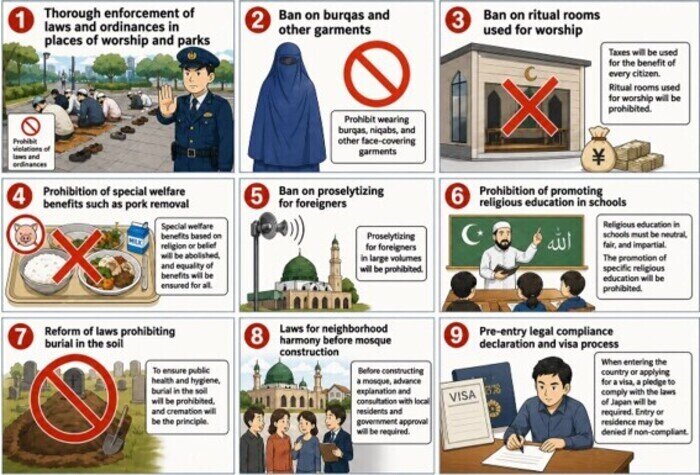
―① Strict enforcement of laws regarding street prayers and prayers in parks; ② Legislation banning the burqa and similar garments; ③ Prohibition of prayer rooms funded by public money; ④ Prohibition of special school meals that exclude pork; ⑤ Legislation banning the public call to prayer (adhan); ⑥ Prohibition of the promotion of religion in school education; ⑦ Legislative amendments to prohibit burial; ⑧ Legislation requiring community consultation prior to mosque construction; ⑨ Reforms to visa policies and a declaration of compliance with laws upon entry
■ Specific Details of the Request
On February 15, 2026, we formed the “Group for Considering the Treatment of Islam under the Constitution of Japan.”
https://note.com/nippon_standard/n/na304e248f407
At that time, we drafted a statement of purpose and reached a consensus on requesting the government to conduct research and studies. We then continued discussions on specific policies and finalized a nine-point request on April 16.
Part 1: Research and Study
In order to uphold the Constitution of Japan and other legal norms, and to further our understanding of them, we request the following research and study.
Recently, as the number of residents in Japan from countries where Islam is the dominant religion has increased, many Japanese citizens have expressed unease regarding issues such as street and park worship, the construction of mosques, women whose faces are not visible, and requests for burial in the ground—partly because Islam is a religion with which they are unfamiliar.
Since it appears that Islam includes organizations banned in their home countries—and some of which are reportedly unable to make the pilgrimage to Mecca—it is only natural that the public feels uneasy about these matters, no matter how much leaders explain that “criminal acts and terrorism are contrary to Islamic doctrine” or that “that is not Islam.” The Public Security Intelligence Agency’s annual “Review and Outlook on Domestic and International Affairs” provides some insight into the global terrorist situation, but there is no way to know how these groups are infiltrating Japan.
Therefore,
(1) The Agency for Cultural Affairs shall include Islam in its Religious Yearbook alongside Buddhism, Shinto, and Christianity.
(2) The government should conduct research and studies to introduce the various Islamic sects and religious movements present in Japan, including their characteristics, approximate numbers by country of origin, and the existence and nature of any issues arising in Japan.
(3) The government should conduct research and studies on the various precepts of Islam, identifying and organizing those that appear to conflict with legal norms set forth in Japanese laws and regulations—including those pertaining to the separation of church and state—within the framework of the Japanese Constitution.
Part 2: We request the following nine items.
You can read the reasons behind each of the nine requests here. https://note.com/nippon_standard/n/n8858b184f38b
Section 1:. Regarding worship on roads and in parks.
The police are requested to strictly enforce
regulations to ensure that worship on public roads does not violate the Road
Traffic Act or the Penal Code. Local governments and other relevant authorities
are requested to strictly enforce regulations so that gatherings in parks are
limited to the scope, location, time, and manner specified in the permit, and
to prohibit religious activities.
We
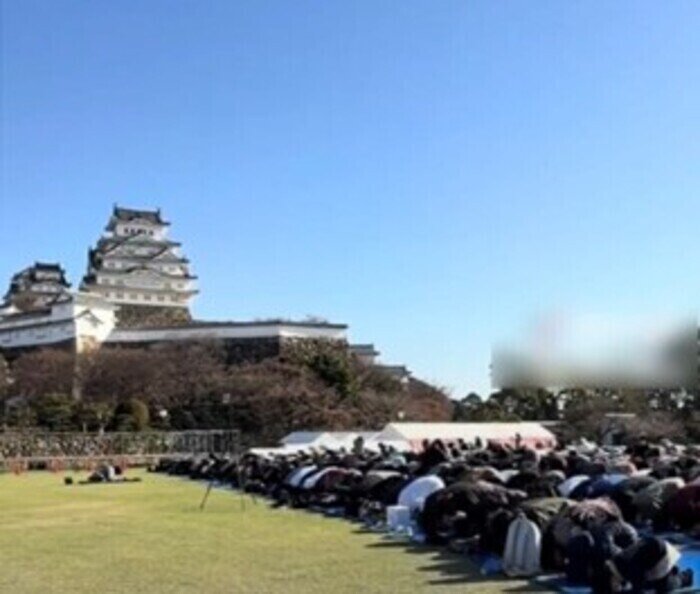
ask that Islamic leaders comply with these requirements and refrain from
holding worship services at locations deeply associated with traditional
Japanese culture, such as castles and historic sites, and from publicizing such
activities online or elsewhere.
Section 2: Regarding situations where the face cannot be identified outside of private settings.
We call
on the Diet to enact legislation prohibiting the wearing of full-face helmets,
balaclavas, and other items that obscure the face—such as the niqab and burqa
(the hijab is excluded because it allows the face to be seen)—except in cases
where health or disability necessitates it, and except when driving.
Section 3: Regarding Prayer Rooms.
We demand
that the national and local governments refrain from establishing any prayer
rooms or other religious facilities within their public facilities, and that
private facilities—such as train stations—which effectively receive public
subsidies do the same.
Prayer
rooms should be leased and established by the Islamic community.
Section 4: Special Meals in Schools and Public Childcare Facilities
We urge
the national and local governments to provide halal meals for Muslims or
special meals that exclude pork and pork extracts, as well as special meals for
other religions, and to refrain from serving standardized meals that merely
reduce the use of pork.
Section 5: Audio Broadcasts from Religious Facilities, etc.
We call
on the national and local governments to enact laws prohibiting audio
broadcasts—made via loudspeakers or similar devices audible to the public—in
any language, except those made by public agencies.
Section 6: Regarding Religious Education.
We call
upon the Ministry of Education, Culture, Sports, Science and Technology and
local governments to ensure that, in public school education, instruction for
high school students and above is limited to general knowledge—such as the fact
that there are various religions, and an overview of their history, doctrines,
and rituals—and to take measures to prevent the teaching of such matters, let
alone worship practices or specific doctrines, to students in junior high
school and below.
Furthermore,
we request that private religious schools, kindergartens, and similar
institutions be instructed to disclose and explain the specific content of
their religious education to parents before they decide whether to enroll their
children.
Section 7: Regarding Burial.
We urge
the Diet to amend the Act on Cemeteries and Burials to prohibit burial in
principle, in light of the current situation where cremation has become the
norm due to historical factors such as public health and land issues, and where
other forms of burial are generally prohibited.
In the
meantime, we urge local governments to designate all areas within their
jurisdictions as zones where burial is prohibited, with the exception of
existing facilities.
Section 8: Construction and Acquisition of Religious Facilities.
We urge
the national and local governments to ensure that, when religious organizations
construct or acquire religious facilities, the process goes beyond merely
verifying compliance with urban planning and building codes, or fulfilling the
minimum requirements of posting notices on project bulletin boards and holding
explanatory meetings only if requested by nearby residents. Instead, to
facilitate coordination with residents in the surrounding communities, In light
of the fact that, when establishing industrial waste treatment facilities or
opening large-scale retail stores, appropriate explanations must be provided to
local residents and their opinions must be respected, we urge the prompt
establishment of similar laws and guidelines.
Section 9: Immigration Policy.
We urge
the government to recognize that, as long as immigration policies do not
violate the Constitution, the government has the freedom to set its own
policies. We demand that the government refuse entry to individuals who do not
explicitly state that they will abide by the laws of Japan, and that it issue
different types of visas to nationals of countries that do not understand the
principle of separation of church and state.
Please provide the above.
Links
https://x.com/Nippon_Standard
https://note.com/nippon_standard
Address: 5th Floor, Park Road Yamato Building, 2-1-15 Chuo, Yamato City, Kanagawa Prefecture , Japan 242-0021
FAX: 046-263-0375
Email: nippon.standard.2026@gmail.com
■ The second deadline is July 15, 2026.
(Sign-up for the English version begins on June 4, 2026)
■ How to Show Your Support
Donations are voluntary, so you are welcome to simply sign the petition. Please note that the “support” mentioned here refers to a token of appreciation that will be sent to you after the final deadline for signatures next year or later. Once the association is established, we will need funds to cover travel expenses for outreach, research, printing costs, and other expenses. Therefore, we would greatly appreciate it if you could make a donation to the “Sagami Agricultural Cooperative” account listed at the end of the association’s mission statement on Note.
https://note.com/nippon_standard/n/ne78920586b47
To ensure that your support is not in vain, we will take on this responsibility with even greater dedication until the very end.
“Japan Forum for Constitutional Dialogue on Islam”
Co-Chair: Taro Takimoto (Attorney)
Co-Chair: Shigeyuki Hozumi (Business Executive)
新着報告
こんにちは。
当会のこの賛同署名が、最近急激に増え15,288人となりましたす。ありがとうございます。圧倒的な声を国政に伝えるため、どうか更に倍旧のご協力をお願い申し上げます。
また、健二・サイエット氏―波切神社、忠魂碑そして長崎の平和祈念像などで「アッラーの外に神は無し」詠唱行為をネットにアップした人―についての、長崎の原爆遺族会会長らが発起人のこちらの署名は、まだ2,904人です。こちらにもどうかご署名をして頂けますよう、どうかお願い申し上げます。
https://voice.charity/events/17293
メッセージ


日本はこれまで、声を上げなかったことで、多くの大切なものを失ってきました。
暮らしの安心、豊かな自然、受け継がれてきた文化。失ってからでは、取り戻せないものがあります。
私たち一人ひとりに大きな権力はありません。けれど、誰にでも社会を動かせる力があります。それが「声」です。
声を上げなければ、何もなかったこととして社会は進んでいく。でも、一人の声にもう一人の声が重なり、何千、何万となれば、社会を動かす力になる。
黙って大切なものを失うのではなく、私たち自身の声で、日本の未来を守りたい。私達は、その想いでVoiceを運営しています。
署名数170万名以上、寄付総額2億円以上。
Voiceは、日本最大級のオンライン署名サイトです。